
9 SignalHire Alternatives for Recruiting and Sales Teams
Julien K.Published Updated
Key takeaways:
- SignalHire splits its plans by data type rather than volume. On annual billing Emails and Phones each run $57 and the combined tier is $83, so buying both separately costs more. Month to month that reverses hard: $82 and $74 separately against $327 combined.
- Credit counts on its pricing page move with a slider, so the 12,000 and 5,400 figures are positions on a scale rather than fixed allowances. Quote the price, check the credits yourself.
- Only Coresignal publishes every tier. Seven of the nine, ourselves included, publish the self-serve prices and quote the tier a growing team ends up needing: our Platform agreement, Apollo's Custom plan, Lusha's Scale, RocketReach's team plans, People Data Labs' Enterprise, UpLead's Professional and ContactOut's team plans. Cognism publishes no price at all, and it and Lusha are the only two here that publish anything about refresh cadence.
- Sourcing and selling want different tools. A recruiter browsing candidates needs an interface; a recruiting product needs an API, and the two are rarely the same purchase however similar the underlying data looks.
SignalHire is built for someone with a browser open. You find a person, click, and get an email or a phone number, with an extension, an ATS integration and bulk search behind it. Its free plan is real, its paid tiers are published, and every paid tier includes unlimited users and unlimited exports, which is unusual in a market that mostly bills by the seat.
What sends people looking for SignalHire alternatives is usually one of three things. The credit arithmetic stops being predictable, the coverage thins out in a region or a seniority band that matters, or the work moves from a browser into software and the extension stops being the point.
That last one is a different purchase entirely rather than a cheaper version of the same one, and it is why a seat-based tool and a flat B2B contact database can both look like the answer to the same question.
This guide compares nine tools on what they publish, what they charge for, and whether they fit a recruiter clicking through profiles or a product calling an API. Reverse Contact is ours, so it goes first, and the thing it cannot do sits in its own Cons block. Prices were read on each vendor's own pages in October 2026.
Where SignalHire Stops Fitting
SignalHire publishes more than most of this market, which makes its limits easy to describe without guessing at them.
Plans are split by data type, not by volume. Emails is $57 a month on annual billing, or $82 month to month. Phones is also $57 annually, or $74 monthly. Emails & Phones is $83 annually against $327 monthly, which is the steepest annual discount on the page and a strong push toward the yearly commitment.
The credit figures move. Each card carries a slider, so the 12,000 credits shown against Emails and the 5,400 against Phones are the values at one slider position rather than a plan allowance. The combined tier displays an unlimited symbol instead of a number.
Job-change tracking is quote-only. It appears on the Scale tier alongside bulk licensing and custom contact details, and nowhere below it. A recruiting team that wants to know when a placed candidate moves has to go through sales.
It is an interface first. The extension, the bulk search and the ATS integration are the product. There is API access on every paid tier, but the shape of the thing is a tool a person opens, which is exactly right for a recruiter and exactly wrong for a platform. The same divide runs through the email finder tools market, where the cheapest option is often the one you cannot automate.
That last point is the one worth sitting with, because it decides which half of this list you should be reading.
Sourcing and Selling Are Not the Same Purchase
The reason SignalHire shows up on both recruiting and sales shortlists is that the underlying data overlaps almost completely. A name, a current employer, a title, an email, a phone number. The jobs built on top of that data have almost nothing in common.
A recruiter works one person at a time and needs judgment at every step: is this the right seniority, has the person moved recently, is the title inflated. The tool has to show its work, which means an interface and a profile view. A sales team doing the same thing in bulk wants filters and exports instead.
A recruiting product is a third case. Here the data is an input to something your customers see, and nobody is clicking anything.
A co-founder at an AI recruiting startup described agents that now run the whole top of the funnel, screening and interviewing candidates at scale. That turns people data into a pipeline input rather than something a recruiter browses. Another founder put the gap more bluntly: for a product like that, missing contact data is the blocker, because without it the customer cannot act on a shortlist at all.
The practical split looks like this.
| What you are doing | What the tool must have | What matters less |
|---|---|---|
| Recruiter sourcing one role | Profile view, extension, ATS write-back | Rate limits, response schema |
| Sales team building a list | Filters, bulk export, seat pricing | Candidate-specific fields |
| Building a recruiting product | API, documented errors, consistent schema | Any user interface at all |
| Enriching your own signups | Real-time single lookups, low latency | Search and list building |
Buying across that line is how teams end up paying for an interface nobody opens, or wiring a browser extension into a workflow it was never built for. That third case, where the data feeds a recruiting product rather than a person, is the one we are built for and the one SignalHire is not.
The 9 Best SignalHire Alternatives
The table below is the buying view: who each tool is for, what it costs to start, and whether you can read that cost without a sales call.
| Tool | Best for | Pricing (from) | Price published? | Interface or API |
|---|---|---|---|---|
| Reverse Contact | Recruiting and sales products | Packs from $100; plans from $249/mo | Partly, Platform quoted | API only |
| Apollo.io | Sales teams wanting one seat | $49/seat/mo billed annually | Partly, Custom quoted | Both |
| Cognism | European mobile coverage | Quote only | No | Both |
| Lusha | Click-to-reveal prospecting | $37.45/mo billed yearly | Partly, Scale quoted | Both |
| RocketReach | Individual researchers | $33/mo billed annually | Partly, team plans quoted | Both |
| ContactOut | Recruiter sourcing workflows | $49/mo billed annually | Partly, teams quoted | Interface first |
| People Data Labs | Developers building on raw data | $98/mo or $940/yr | Partly, Enterprise quoted | API only |
| Coresignal | Volume data for HR tech | $49/mo for 2,500 credits | Yes, in full | API only |
| UpLead | Verified contacts with a guarantee | $74/mo billed annually | Partly, top tier quoted | Both |
We put Reverse Contact at the top because we make it. Everything after that runs roughly from the broadest sales platforms toward the specialists, with the three interface-free data APIs gathered near the end. Teams comparing the sales half of this list often land on the same names found among Lusha alternatives.
1. Reverse Contact
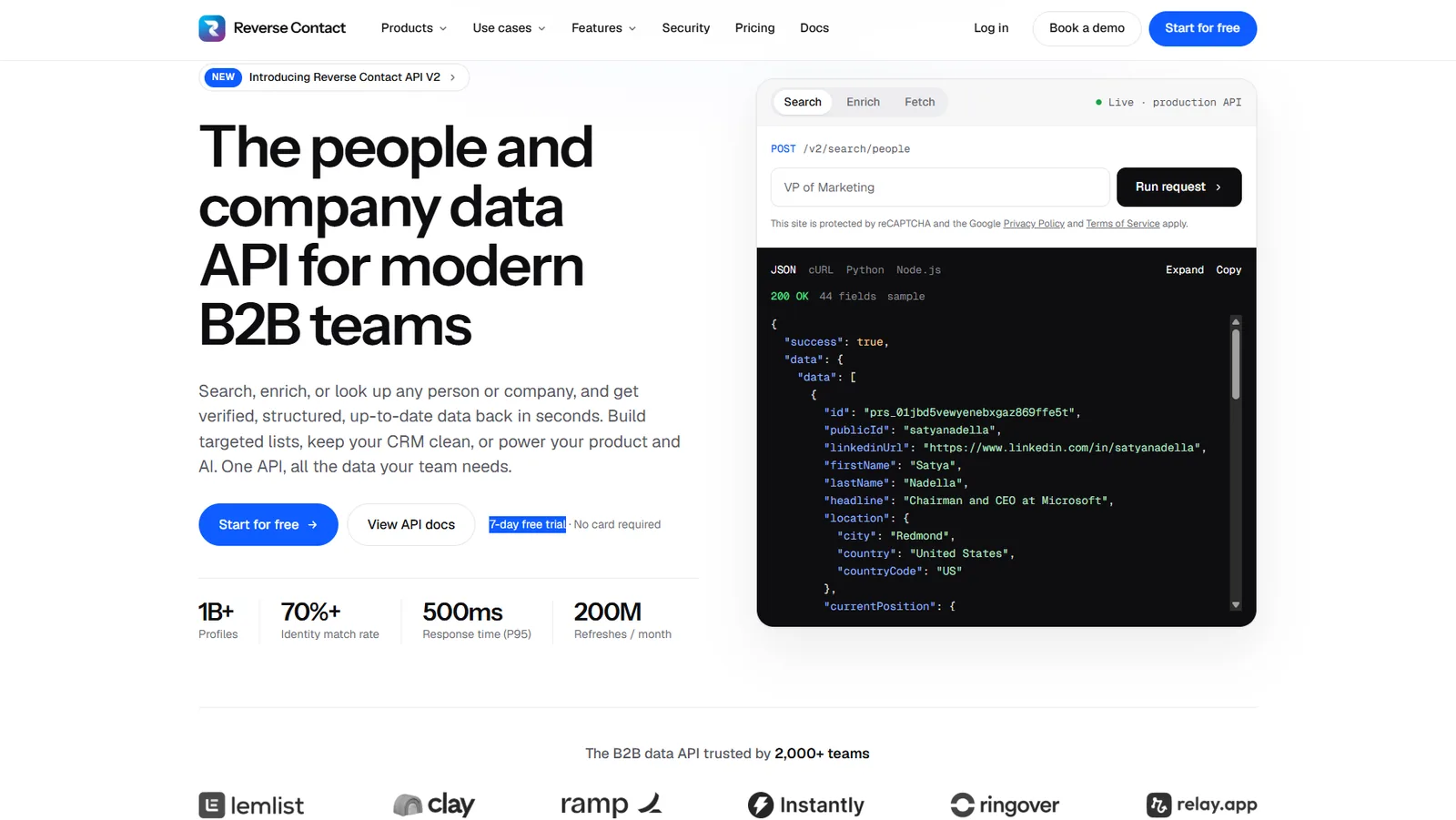
Best for: Recruiting and sales products that need the data, not the dashboard.
Overview: Reverse Contact is one of three entries here with nothing to open at all, and the only one of those three built around resolving a single identity. It is an API. There is no extension, no candidate list to browse and no ATS integration, because the product is the layer underneath those things rather than the thing itself.
You search people by role, seniority, department, location or industry, or you resolve a single identity from an email, a name with a company domain, or a company name. Either way a structured profile comes back in one consistent shape. Those filters are only as good as the fields behind them, so we publish the fill rate of each one: in the October 2026 snapshot, function and seniority were filled on 90% of quality profiles (at least one position, one follower and a page still online), education on 61% and skills on 56%.
Contact data runs as separate calls. An email costs 3 credits and a phone lookup 20, and neither is billed unless something comes back. A live profile re-fetch is the one call that bills on an empty result, at 2 credits.
Recruiting products tend to use this at both ends of the funnel. One co-founder of an AI recruiting startup described agents that source and screen without a recruiter browsing anything, which makes structured search the main call rather than a convenience.
The other end is signup. Where a product collects a few details from a new user and wants a fuller picture before routing them, the same enrichment call runs in the background rather than on a recruiter's screen. Both paths are the same API doing the same job at different moments.
Key features:
- Search across 30+ criteria, with a free count of how many profiles match before you spend a credit.
- Agentic search that takes a plain sentence describing who you need.
- Lookalike search from one seed profile.
- A
/checkcall, free, that reports when a record was last rebuilt before you decide to pay for a fresh one. - One response shape across REST, webhooks, CSV upload and MCP.
Pricing: Nobody is counted, only calls. A $100 credit pack buys in with no subscription and stays valid three months from the day you bought it, oldest credits spent first. Above that, $249 lifts the meter off profile lookups, $449 adds search and $699 adds enrichment from an email or a name, while live re-fetches, emails and phones keep drawing credits on all three. Each of those licenses your own team's use, and showing the data to your customers takes a Platform agreement, priced on application.
Pros: Headcount never appears on the invoice, every self-serve price is published rather than quoted, failed email and phone lookups are not billed, and segment sizing is free
Cons: A recruiter has nothing here to open, so the day-to-day tool stays where it is; a phone lookup is the costly one at 20 credits beside an email's 3; an empty live fetch still bills 2; and coverage runs strongest across the Americas and Europe, thinnest across Asia-Pacific
How to start using it:
- Sign up. The trial credits need no card.
- Run a count query first. It is free, and it tells you whether the segment you recruit for is actually covered.
- Push 200 real candidates or prospects through and record how many resolved and how many resolved correctly.
- Divide credits spent by usable records. That is your cost, not the pack price.
- Talk to us about Platform first if the data will reach your own customers.
Why it's a good SignalHire alternative: It replaces the data behind the tool rather than the tool, which is the right trade when the lookups are happening inside your own product.
Final verdict: Right for a recruiting or sales product with real volume. Wrong for a recruiter who needs somewhere to work.
2. Apollo.io
Best for: Sales teams who want data and outreach in one seat.
Overview: Apollo wraps a contact database in a sequencer, a dialer and a light CRM, which covers the selling half of SignalHire's audience comfortably and then some.
Key features:
- Credits arrive per seat, with eight spent on a phone number against one on an email.
- A database of 240M+ contacts and 30M+ companies sits behind the filters.
- Bounce within 30 days and the credit comes back.
Pricing: Everything is priced by the seat: $49 a month on annual billing for Basic, $79 for Professional, and $119 for Organization, which demands three seats and offers no monthly option. Free accounts get 900 credits a seat a year, granted monthly. Its help pages put the email match rate at 84%.
Pros: Sequencing and dialing included, a genuine free allowance, rates published openly, bounces refunded
Cons: The allowance is tied to headcount rather than to how much sourcing you do, so a two-person team working a large list pays twice over, and anything unused dies at each billing cycle including credits you bought separately
Why buyers shortlist it: Nothing else publishes a lower price for a database and a sequencer bought together.
Final verdict: Strong for a sales team. Thin for recruiting, where the filters and the fields are built for buyers rather than candidates.
3. Cognism
Best for: European mobile numbers and regulated outbound.
Overview: Cognism sells on phone quality in Europe, with screening against 16 Do-Not-Call lists built into the product rather than sold on top.
Key features:
- Screening against 16 Do-Not-Call lists ships as standard rather than as an add-on.
- Director-level and above reaches 90% coverage in Europe and the US.
- One credit reveals one contact, and it spends the same way in the app, in the enrichment product and over the API.
Pricing: Quote only, and packaged around five included seats whether the team is that size or not. Both Standard and Pro work that way, and both carry emails and mobiles; Pro adds a premium mobile filter, on-demand verification and intent data.
Pros: Genuine European phone depth, DNC screening as standard, a published refresh cadence, API from the first tier
Cons: No price is published anywhere, the smallest package assumes five seats, and CRM enrichment is sold as a separately priced add-on rather than included in either package
Why buyers shortlist it: For European calling it is the most credible phone dataset in this comparison.
Final verdict: The right call for EMEA outbound. Hard to evaluate without entering a sales process.
4. Lusha
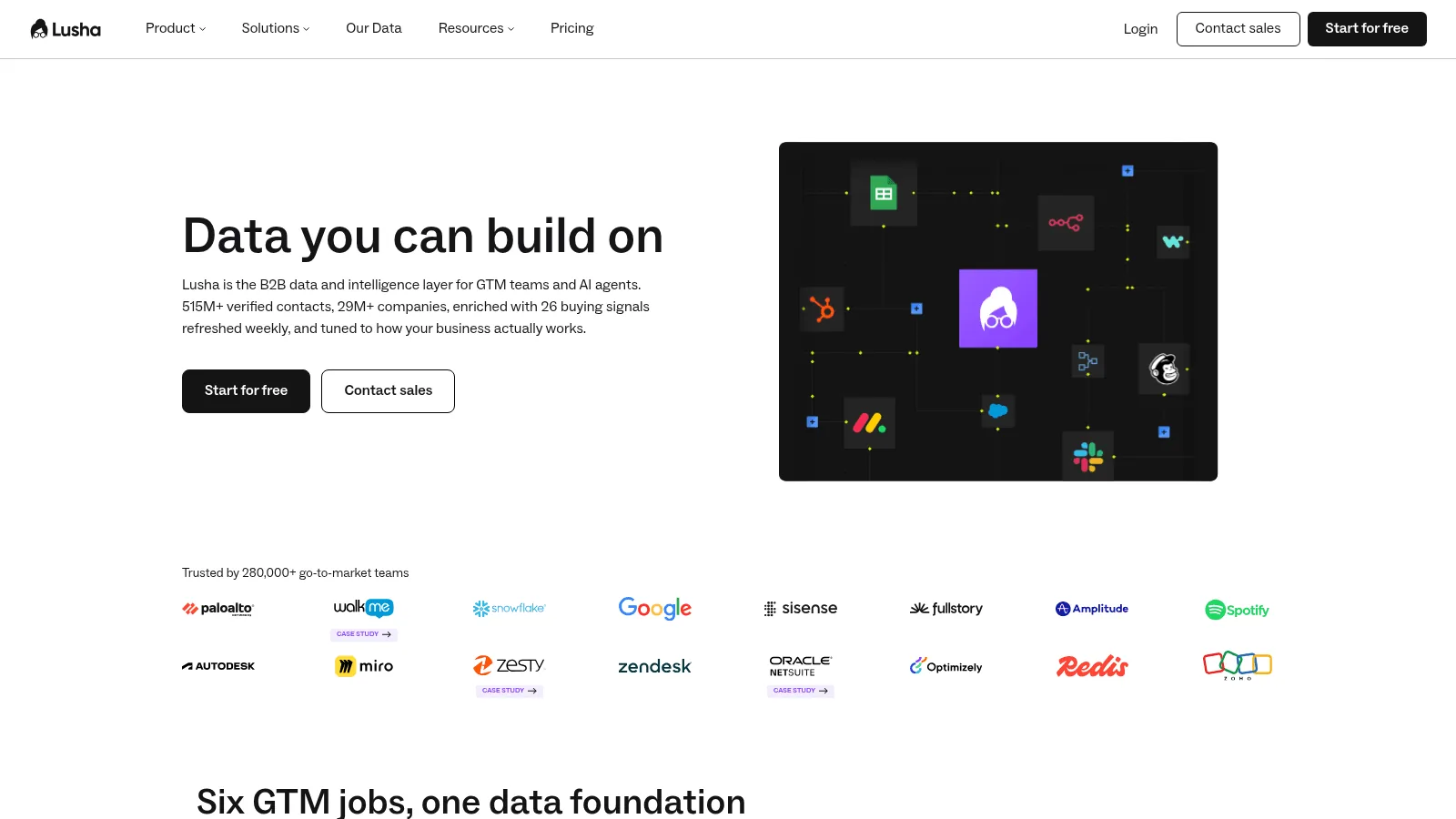
Best for: Click-to-reveal prospecting with a published ladder.
Overview: Lusha is the closest like-for-like swap for SignalHire's core habit: open a profile, click, get a contact.
Key features:
- Billing is per data point, so revealing a person's email and phone together costs six credits rather than one.
- Behind it sit 515M+ contacts and 29M+ companies.
- Every plan has API access, though the free and entry tiers are rate-limited hard.
Pricing: Seats come bundled into the tier rather than billed on top. Starter carries one seat at $37.45 a month on yearly billing, rising to $49.90 paid monthly. Pro bundles two seats at $52.45 or $69.90, and Premium five at $299.95 or $399.90. The free plan carries 40 credits a month and Scale is quoted.
Pros: A real free tier, published per-credit costs, seats bundled into the plan, unusually detailed freshness reporting
Cons: Its own documentation is clear that a yearly allowance dies with the term rather than carrying forward, and every API request costs at least one credit whether or not it returns anything, a rule you feel only once the calls are automated
Why buyers shortlist it: The pricing is legible in a way most of this market is not.
Final verdict: A clean swap for the same workflow. Watch the annual forfeiture before committing to a year.
5. RocketReach
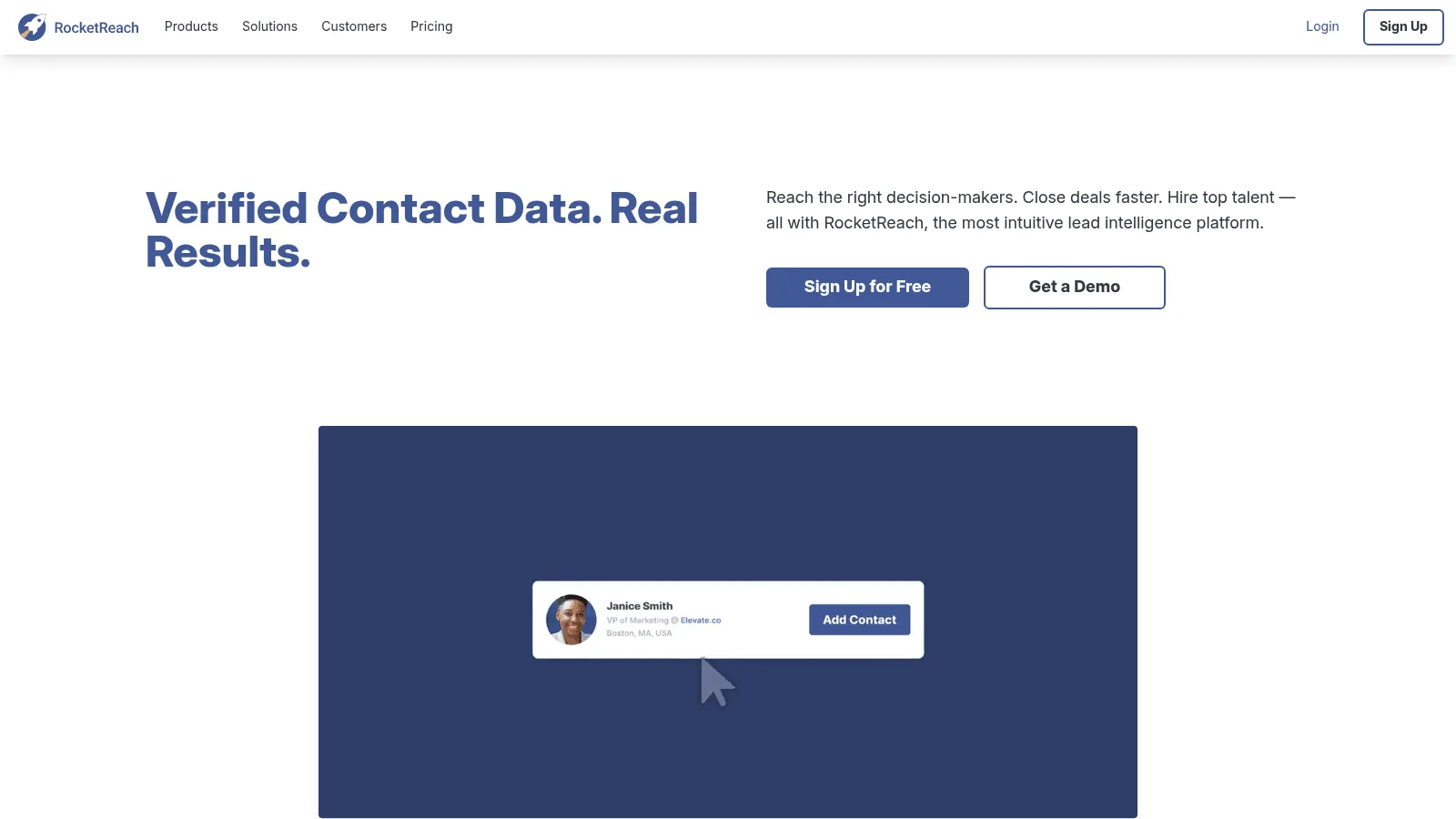
Best for: Individual recruiters and researchers.
Overview: RocketReach sells lookups rather than fields, so one successful lookup returns the contact details it holds for that person instead of charging per item.
Key features:
- Nothing is spent unless the lookup returns a verified email or phone; failures are refunded.
- The search runs across 700M profiles and 60M companies.
- Every paid tier carries MCP and API access.
Pricing: Licenses are individual. On annual billing Essentials costs $33 a month and excludes phones, Pro costs $75 and includes them, and Ultimate costs $142; month to month those become $69, $119 and $209. Team plans open around $6,000 a year. Annual accounts advertise unlimited lookups while capping exports at 1,200, 3,600 and 20,000 a year.
Pros: Failures refunded by stated policy, one charge covering both contact types, API on all paid tiers, five free lookups to start
Cons: A recruiting team scales badly against per-seat pricing, and the word "unlimited" on the annual plans refers to lookups while exports stay capped, which is not obvious until after signing
Why buyers shortlist it: Of everything here, this is the model that needs the least explaining to a finance team.
Final verdict: Good for one or two researchers. Expensive the moment a team needs licenses.
6. ContactOut
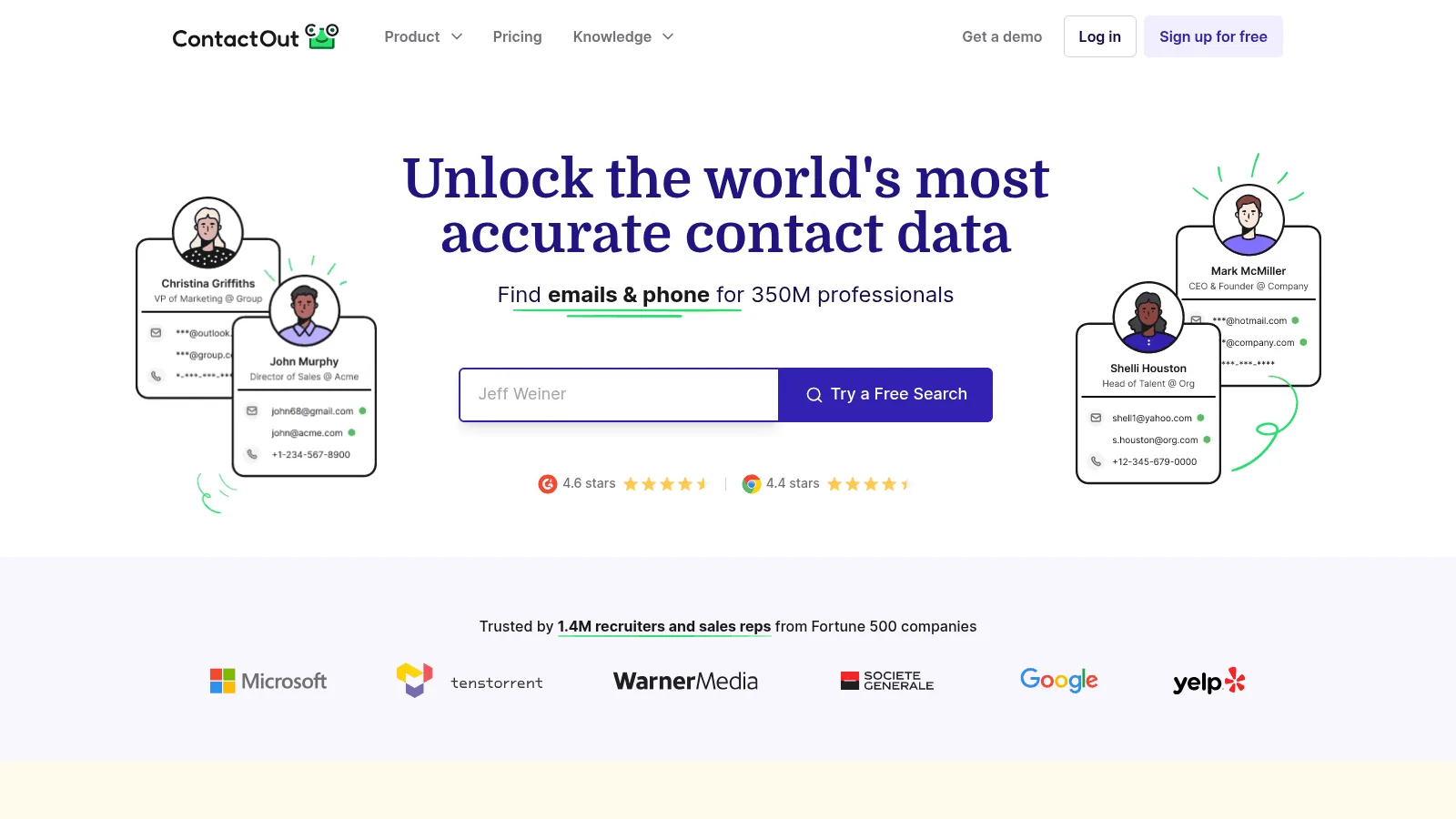
Best for: Recruiter sourcing workflows in the browser.
Overview: ContactOut is the most recruiter-shaped tool here, built around a browser extension that surfaces contact details while you work through profiles.
Key features:
- Email-only and email-plus-phone plans, rather than one ladder.
- Its own pages claim contact details for 75% of people online, with no method published.
- Team and API pricing handled through sales.
Pricing: Free gives five emails, five phones and five exports a day, described as a limited-time offer. Email is $49 a month billed annually against a struck $99, and Email + Phone is $99 against $199, both single-user.
Pros: Built for the sourcing workflow rather than adapted to it, a usable daily free allowance, clear split between email-only and phone tiers
Cons: Its "unlimited" paid plans are capped in the terms at 2,000 email and 1,000 phone credits per account each month, its own pages give two different profile counts, and team or API access needs a sales conversation
Why buyers shortlist it: For a recruiter who lives in the browser, the workflow fit is better than anything else here.
Final verdict: Strong for hands-on sourcing. Not a data layer, and the caps deserve reading before you buy.
7. People Data Labs
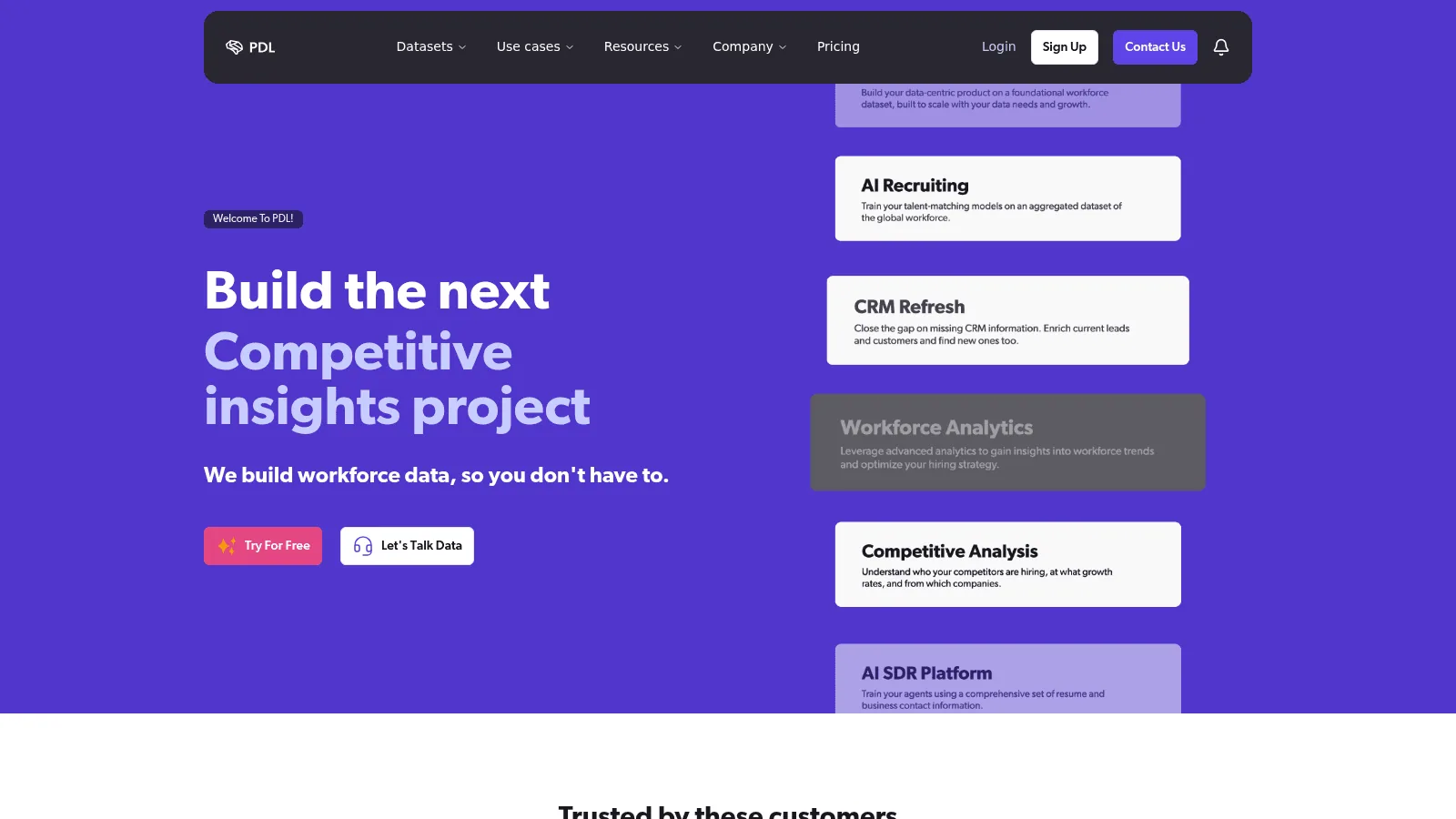
Best for: Developers who want raw records and will build the rest.
Overview: People Data Labs ships raw person and company datasets for developers to build on, with no prospecting application on top.
Key features:
- Person and company data are sold as two separate APIs with their own plans.
- A credit buys a record on either one.
- Bulk data licensing is available on Enterprise terms for teams that want feeds rather than calls.
Pricing: No seats at all, just two parallel products. The person API runs free on 100 credits a month with the contact fields obfuscated, then $98 monthly or $940 yearly from 350 credits. The company API takes the same shape at $100 monthly or $960 yearly from 1,000 records. Every plan carries API access, and Enterprise adds bulk licensing.
Pros: Published dataset statistics rather than marketing totals, a free tier that exercises the real API, honest about being infrastructure
Cons: The free tier hides the contact fields, which is the half most buyers want to test, and there is no interface at all, so a recruiter has nothing to use
Why buyers shortlist it: When you are building rather than browsing, raw records at a published rate is the whole requirement, which is the same reason it anchors most comparisons of People Data Labs alternatives.
Final verdict: A serious option for a product team. Useless to a working recruiter.
8. Coresignal
Best for: HR tech that needs volume and a readable ladder.
Overview: Coresignal sells employee, company and job-posting data through an API aimed squarely at platforms rather than end users.
Key features:
- Seven published tiers run from a $49 entry up to $5,000 a month.
- A job posting costs a single credit, while an employee or company record costs 10 to 20.
- It ships as REST endpoints and webhooks, with agentic search and an MCP server alongside.
Pricing: Volume sets the price, never headcount. A seven-day trial carries 2,000 credits; after that Mini buys 2,500 credits a month for $49, Starter 12,000 for $199, Pro 35,000 for $499, and four further tiers climb to $5,000. Committing to a year takes 10% off and grants the credits upfront.
Pros: The most complete published price ladder here, job-posting data most rivals lack, a real trial
Cons: Credits generally do not roll over, record costs of 10 to 20 credits make per-record arithmetic harder than a one-credit model, and there is no interface or workflow of any kind
Why buyers shortlist it: Job-posting data alongside people records covers a sourcing use case the contact tools do not touch.
Final verdict: Good for a platform with volume. Not something a recruiter can open.
9. UpLead
Best for: A verified contact with a guarantee attached.
Overview: UpLead is a searchable database that verifies emails at export, with a Valid Only export mode that withholds invalid addresses rather than billing for them.
Key features:
- A single credit covers the whole contact, mobile included, rather than billing each field.
- Filters run across 200M+ records.
- Extra credits cost 60 or 50 cents depending on tier.
Pricing: Both published tiers are single-user. Essentials costs $99 monthly or $74 on annual billing, which works out at 2,040 credits a year, and Plus costs $199 or $149. Professional is quoted, sold annually only, and the one tier carrying full API access. Its trial lasts seven days and carries five credits. Accuracy is claimed at 95%.
Pros: One charge for the whole contact, bad addresses held back instead of billed, an accuracy figure stated publicly
Cons: Neither published tier allows a second user, the API in full is reserved for a quoted annual plan, and a five-credit trial cannot tell you anything about your own list
Why buyers shortlist it: One credit per whole contact means the budget is a multiplication rather than an estimate.
Final verdict: Fine for one seller who wants search. Awkward for a team and weak for a build.
Evaluating a Candidate-Data Vendor
Recruiting data gets evaluated badly, usually because the test measures whether records came back rather than whether they were right about the person.
Test on the roles you actually fill
Coverage is not uniform. A vendor strong on software engineers in North America can be thin on field technicians in Southeast Asia, and a blended match rate hides both. Build a test set of 200 people from the roles, seniorities and regions you recruit for, and run it through every vendor on the same day.
Score two numbers rather than one. How many resolved, and how many resolved to the right person. A vendor answering for 90% of your list while getting one in ten wrong gives a recruiter more rework than one answering for 70% and almost never wrong.
Check what freshness actually means
A stale title is worse than a blank one, because nobody checks a field that looks filled. Ask each vendor what their refresh date refers to: the last time the whole profile was rebuilt, or the last time any field on it changed. Those are different claims and only one of them tells you whether the current employer is current.
Cognism publishes a 30-day cadence covering 95% of its Director-level and above, and Lusha publishes refresh rates field by field. Most vendors here publish neither, which is worth knowing before you build a workflow that assumes the title is right.
Think about what the data will decide
If the records feed a product rather than a person, the stakes change. The EU's AI Act lists employment and workers' management among its high-risk categories, naming systems used for recruitment or selection, including placing targeted job adverts, filtering applications and evaluating candidates.
NIST makes the practical version of the same point. Its study of bias in AI describes hiring systems built on proxies, using inputs like time in prior employment or distance from the workplace to stand in for something nobody can measure directly, and notes how those proxies quietly disadvantage particular groups. Enrichment fields are proxies too. A seniority label inferred from a job title carries whatever assumptions produced it.
The defensive move is unglamorous and worth doing anyway: record which fields are observed and which are inferred, and keep the inferred ones out of anything that filters a person out. Teams building this properly tend to want the raw record and their own logic on top, which is what a people search API is for.
Choosing Between Them
Start from which side of the sourcing-and-selling line you are on.
If you are a recruiter in a browser, ContactOut fits the workflow best and Lusha is the closest swap for SignalHire's click-to-reveal habit. If you are selling rather than hiring, Apollo.io covers data and outreach at one price, and Cognism is the one to beat on European mobiles. If one or two people do the work, RocketReach's refund-on-failure model is the simplest.
If the lookups happen inside software, the three API options separate cleanly. People Data Labs prices a record flat and hands over the whole thing, Coresignal brings job postings, and our own job is narrower: get one identity right, and surface the competing candidates when a match is genuinely ambiguous instead of choosing for you.
Take a free API key, run a count query on the roles you actually recruit for, and run a few hundred of your own records through it before anyone signs anything.
FAQs
What is the best free SignalHire alternative?
Apollo.io's free plan is the most generous at 900 credits per seat per year, and it includes sequencing. Lusha gives 40 credits a month, RocketReach five lookups, and ContactOut five emails and five phones a day.
People Data Labs has a free tier of 100 credits but obfuscates the contact fields, so it tests the API rather than the data. What we offer is trial credits and no card, not a free tier, and we would rather name it accurately than pad the comparison.
Which SignalHire alternatives include phone numbers?
Apollo.io at 8 credits, Lusha at 5, RocketReach from its Pro tier, UpLead bundled into the contact credit, ContactOut on its combined plan, and ourselves at 20 credits per lookup that finds one. Cognism is the specialist here, and it includes mobiles in both of its packages rather than holding them for the upper tier. Expect a mobile to cost several times an email everywhere.
Do any SignalHire alternatives track job changes?
SignalHire itself puts job-change tracking on its quote-only Scale tier. Among the alternatives, Cognism and Apollo.io surface role changes inside their platforms, and LeadMagic sells a job-change check per call. We do not send change alerts and do not monitor profiles; teams that want this build it by re-fetching records on their own cadence and comparing versions, which some of our customers do.
Is SignalHire good for recruiting or for sales?
Both, which is the honest answer and also the problem. The extension, bulk search and ATS integration suit a recruiter, while the unlimited users and unlimited exports suit a sales team that would otherwise pay per seat. It is weakest at the third case, where contact data feeds a product and nobody opens an interface at all.
How much do SignalHire alternatives cost?
Published monthly entries run from $33 at RocketReach and $37.45 at Lusha through Coresignal at $49 for 2,500 credits to People Data Labs at $98 and our own $249.
Our $100 credit pack is a one-off rather than a subscription, so it does not belong on that ladder. Only Cognism withholds its pricing outright, and only Coresignal publishes to the top; the rest of us, ourselves included, publish the self-serve tiers and quote the one a growing team will want.
Compare them on cost per correct record rather than headline price, the same arithmetic that decides between Hunter.io alternatives on the email-only side of this market.
The data layer behind your GTM engine
Access fresh people and company data through one API and power every enrichment, prospecting, and automation workflow.
- Profiles
- 800M+
- Refreshes / month
- 200M
- Response time (P95)
- 500ms